
India's ability to win a quick, pre-emptive war against Pakistan has just been enhanced by a useful new set of teeth.
The Centre for Airborne Systems, DRDO's Bangalore-based unit, has revived the airborne early warning system programme, which was scrapped in 1999 following a crash of the rotodome radar-fitted Avro aircraft near Arakkonam in Chennai.
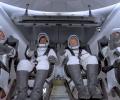
The Lucknow-born Shukla, former NASA astronaut Mission Commander Peggy Whitson, Slawosz Uznanski-Wisniewski of Poland, and Tibor Kapu of Hungary are part of the Axiom-4 mission that marks the return to space for the three nations.
Agni 5 is not China-specific, as some have claimed. It is essential to India's overall security and should be followed by a submarine-launched version, says Premvir Das
The Indian army will have to wait four to five years to acquire Inter-Continental Ballistic Missile Agni-5, which was successfully tested on 19 April by the Defence Research and Development Organisation. Sheela Bhatt reports
India will join the elite club of nations having ICBM with the Defence Research and Development Organisation planning to carry out the launch of over 5,000 km-range Agni-5 missile in April.
With a range of 25km, Akash is one of the five missiles currently under development by the Defence Research and Development Organisation.

In the event of a war with China, AMCA deep strikes would target China's rail and road links with Tibet, isolating PLA divisions there.
K Santhanam, a retired Defence Research and Development Organisation scientist, on Monday accused former Atomic Energy Commission chief Anil Kakodkar of 'ignoring facts' about the yield of the nuclear tests done at Pokhran in May 1998, calling him 'a liar' motivated by institutional loyalties.

The 'On-Board Oxygen Generation System' developed for the Tejas can produce 1,000 litres of oxygen every minute.
India succefully test-fired a 3,000-km Agni-III missile on April 12 this year.

India has tested a 1,000 kg indigenously-developed glide bomb, which successfully hit a target 100 km away, in the Bay of Bengal off the Odisha coast, making the country self-reliant in guided precision bombs.
BrahMos is unique among cruise missiles due to its 2.8 Mach supersonic speed (all other cruise missiles are sub-sonic at present) and much-longer strike range.

Santhanam also sought to counter claims by Narayanan and others in the establishment that he was not privy to the test measurements and information on Pokhran-II tests.
Former Defence Research and Development Organisation scientist K Santhanam, who had questioned the success of the thermonuclear device during the Pokhran-II tests, has favoured an inquiry to determine the results of the 1998 experiments, saying creation of nuclear power could not be based on myths.
India does not need to carry any more nuclear tests, Atomic Energy commission chief Anil Kakodkar said on Wednesday in the backdrop of the controversy over whether the 1998 Pokhran thermo-nuclear explosion was a fizzle.
'There is a change in the administration in the United States of America. They are bound to further pressurise India to sign the CTBT. In such an event it was necessary to make such a statement or speak the truth on the issue so that India does not rush into signing the CTBT.'
Highly placed sources said the test firing could take place any time this month.
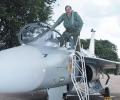
Indian Air Force chief Air Chief Marshal RKS Bhadauria flew a Tejas single-seater light combat aircraft MK1 FOC fighter during his visit to IAF and flight test establishments and facilities of Defence Research and Development Organisation (DRDO) and Hindustan Aeronautics Limited (HAL) in Bengaluru.
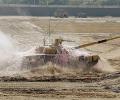
The prospects of India becoming a credible manufacturer of defence platforms or major weapon systems for export are remote, says Vice Admiral Premvir Das (retd).
The missile, weighing 650kg, can carry a 50kg payload over a distance of 25km.
It was the naval version of Prithvi, which has a range of 250 to 300 km.
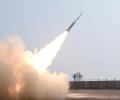
The Integrated Test Range of Defence Research and Development Organisation (DRDO) has taken various measures to protect its facilities at Chandipur and Abdul Kalam Island in Odisha, which are likely to be affected by cyclone 'Yaas', an official said.

Another proposal of the army and the IAF for the procurement of 55 low level light weight radars was also cleared by the DAC for Rs 419 crore.

Organisations that reward constant optimism and penalise negativity create environments where employees feel pressured to hide their struggles, notes Sonica Aron, founder of HR consultancy firm Marching Sheep.

Python-5 missile live firing was conducted to validate target engagement from all aspects as well as beyond visual ranges. In all the live firings, missile hit the aerial target.
Chief Controller (R&D) Dr W Selvamurthy told reporters in Bangalore that about 10 people from the US have been joining DRDO each year and the trend is growing.
A message board on the successful launch of Agni-III

Immediately after exploding, it emits gas which causes breathing difficulty and irritation in eyes.
The supersonic anti-ship cruise missile was jointly developed by India and Russia.

Santhanam recently stirred a controversy claiming that the nuclear tests done in 1998 were not successful as projected at that time.

"This is the picture of ground zero where the thermo-nuclear device was detonated in May 1998 in Pokharan. No crater was found at all! This picture tells the story that we have to do more homework. Indeed, we have to do more honest homework." said K Santhanam, former Defence Research and Development Organisation scientist dramatically holding the picture in his hand in the press conference held in New Delhi.
The indigenously built multi-target missile has a range of 25km and is one of the five missiles under various stages of development by the DRDO.
India is ready to export missiles to countries whose names are cleared by the government, top DRDO scientist S Prahlada has said, disclosing that trade inquiries have been received from at least five nations. Though Prahlada did not name the missiles, which could be offered in world market but sources said that India could place Indo-Russian supersonic cruise missile Brahmos and recently tested surface-to-air missile Akash for sale.
DRDO scientists, who conducted the test, described it as a user's trial.
The K-15 missile, which has a range of 700 km, was test-fired from an undersea launcher.

The Central Bureau of Investigation has arrested Delhi lawyer Gautam Khaitan in the case of alleged commission paid by Brazilian aircraft manufacturer Embraer to a UK-based NRI middleman to swing a three-aircraft deal with DRDO worth $210 million in its favour in 2008, officials said on Thursday.
